
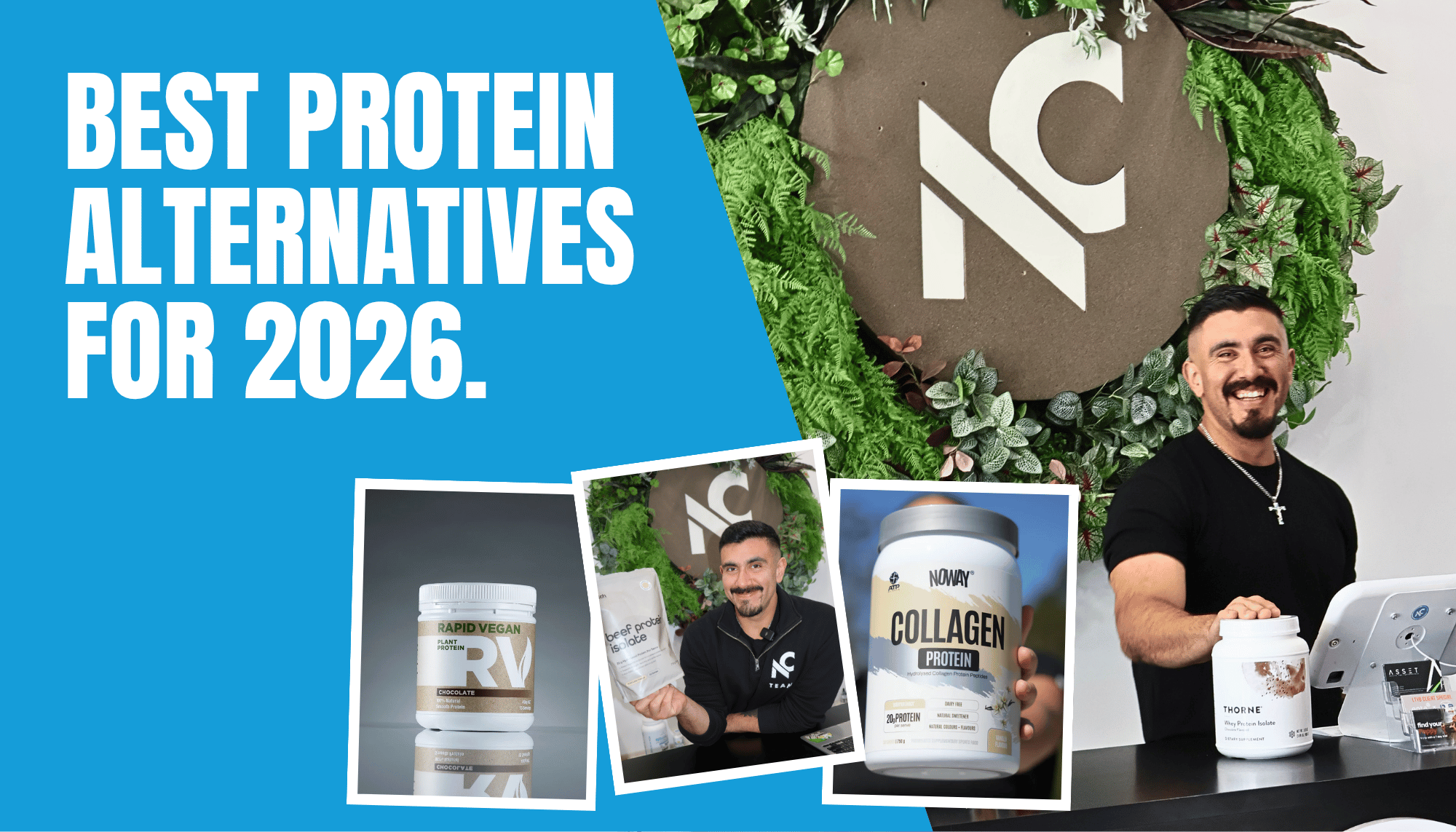
Why Is Whey Protein Getting More Expensive in Australia, And What Can You Take Instead?
If you've picked up your usual tub of whey protein lately and winced at the price, you're not imagining it. Costs have gone up, noticeably, and for people who go through a kilo or two a month it adds up fast.
But there are good alternatives, some of which have been quietly sitting on the shelf the whole time. So let's talk about why prices have shot up, which brands, and how to keep your protein intake consistent without overpaying.
What caused prices to jump
First, whey is a byproduct of dairy manufacturing. Its price moves with the global dairy market. That market has had a rough few years.
Global dairy demand. Whey comes from milk solids. When international demand for dairy rises, raw ingredient prices follow. Supply hasn't kept up, and that flows through to the finished product.
The Australian dollar. A lot of whey protein sold here is imported, or manufactured using internationally traded inputs. When the AUD softens against the USD, those costs go up. Brands absorb it for a while, then they don't, and price rises are passed along.
Freight and manufacturing. Post-pandemic logistics costs never fully came back down. Shipping, packaging, manufacturing overheads, all of it is more expensive than it was in 2019, and supplement brands aren't immune to that.
Pricing lag. Brands don't reprice immediately when their costs rise. They hold for as long as they can, then adjust, which is why increases can feel sudden even when the pressure has been building for a year or more.
Demand pressure. At the same time as all of this, an increase in the general public's interest in health and fitness is coming at protein supplements from the demand side, combining with the above to create a mini price crunch.
So what you're paying extra for isn't a random margin grab. It's the cumulative result of a few years of cost pressures.
Which Brands Have Increased, And Who's Expected to Move Next?We spoke to Jose in store to get the intel on smart buys right now, and where he expects prices to go next. |
 |
Which brands have already increased their prices, and by roughly how much?
"A good example is Optimum Nutrition Gold Standard, one of the market's leading protein brands. It usually sells for $159.95 for the 5 pound tub, has now gone up to $179.95 for that 5 pound tub. And we've had it go up in the past two years from what was originally I think about $114 two years ago, to now $179.
"For context, maybe about six, seven years ago you're looking at around $89 to $95 for that 5 pound tub. Whereas now you're paying $95 for a 2 pound tub. So yeah, the cost has just dramatically risen when it comes to the whey protein."
Which brands are expected to announce further price increases later this year?
"We are expecting all brands, all whey protein powders, to go up in price. There is no one that is immune to this. If there's whey in it, it'll go up in price. There unfortunately have been no brands that have held their pricing as all, even low quality forms of whey protein, have been affected by this shortage. So even the most cheap stuff is now as expensive as premium stuff is what we're finding, or close to."
Are there any brands that have held their pricing and represent good value right now?
"When it comes to value, the only one that's really gonna show good value is possibly something like, I can't even say anything really, 'cause even the one that we did have has just gone up in price too.
"I would say at the moment, Faction Labs 100% whey protein sitting at $89.95 for 1 kilo would be one of the better ones that is on a small price ticket. But when you go bigger, when you're paying, you know, $280 for a 10-pound bag, that obviously is better value per serve, but some people don't wanna lob out that much money in one go at the moment. So yeah, a bit of a catch-22, two different types of customers."
Have we seen brands doing "shrinkflation" moves? Smaller serve counts or smaller tubs at the same price?
"Yes, we've seen some go from 900 grams to a kilo, dropped to 750 grams. But again, the price has also gone up. So it's not that they've gone smaller to keep the price the same. No, they've gone smaller and still had to put their price up, just not as severely because of that shrinkflation move."
Any brands worth specifically calling out as ones to stock up on before a price rise hits?
"I would say for WPI, I would go Cyborg Sport Grass Fed WPI at $109.95 for 1 kilo for WPI premium protein. And the same thing, Faction Labs 100% Whey. It's currently $89.95 for a kilo. Realistically, that should be sitting at $99.95 for the type of whey blend that it is."
Alternatives Worth Knowing About
You don't have to just wear the price increase. These three options are worth a proper look.
Collagen Protein
Collagen has become a lot more mainstream, and the price point is part of why. It usually costs less per serve than whey, dissolves well in hot or cold drinks, and doesn't have the chalky texture some people find off-putting.
It's one of the most abundant proteins in the body, concentrated in connective tissue, joints, skin, and tendons. For people who train hard, especially anyone with niggling joints or who's getting older and wants to stay active, that's a relevant consideration, not just a marketing angle.
It's worth knowing that collagen has a different amino acid profile to whey. It's naturally low in leucine, which is the amino acid most directly involved in triggering muscle protein synthesis. Plain collagen on its own isn't a like-for-like swap if building muscle is your main goal. That said, a growing number of collagen products now add leucine to the formula specifically to address this, which changes the picture considerably. If you're looking at collagen as a protein source rather than just a joint or skin supplement, it's worth checking whether leucine is on the label. Either way, it works best alongside other protein sources rather than as your only one. As a cost-effective addition to what you're already doing, it makes a lot of sense for:
- Active people who want to support joint health alongside training
- Anyone in their 30s or beyond, as collagen production naturally declines with age
- People who find dairy proteins hard on digestion
- Those who want to spread their protein intake across different sources
Vegan & Plant-Based Protein
The plant protein category has genuinely improved. A few years ago the texture and taste were valid complaints. Now there are products that are hard to distinguish from whey in a smoothie, and they tend to be cheaper.
Most good plant proteins blend pea, brown rice, faba beans, nuts and sometimes hemp to cover the amino acid profile more completely. Single-source plant proteins can fall short on certain aminos, and a blend fixes that.
The "vegan" label puts some carnivores off, but don't let it. Plenty of people who eat meat and dairy use plant protein for its easy digestion, affordability, or for variety.
It's a solid and affordable option for anyone, but especially good if you're lactose intolerant or just looking for a cheaper everyday protein that still does the job.
Shop All Vegan & Plant-Based Protein
NihPro
Jose has the intel on this alternative, so let's hand over to him again.
What is NihPro's key point of difference?
"Well, NihPro's key difference is the fact that its amino acid profile sits quite similar to whey protein, which makes it great for muscle building. Most plant proteins unfortunately aren't.
"Its ease of digestion and suitability for everyone, regardless of intolerance or digestive issues, as it's one that can be consumed by everyone. The actual NihPro trademarked ingredient, or that blend, is actually from America, but it is manufactured within Australia. So they obviously import the raw ingredients and then package it here."
How does its price per serve compare to comparable whey products?
"Currently, price per serve sits a lot better than other whey isolates, as this is still an isolate, but compared to whey, it definitely sits a lot better, as that 900 grams sits on the shelf at $89.95, as opposed to 900 gram isolates we are looking to expect to hit at about $109 to $120 for that same size. Obviously, you know, people won't see $90 as good value, but it actually is given the current climate."
Who is it best suited for? Beginner, intermediate, advanced? Specific goals?
"Look, it's best suited for anyone with the goal of using a protein powder for recovery and lean muscle mass. So men, women, anyone with that goal."
Any flavours or formats worth highlighting?
"Yep, vanilla is probably the most suitable one to go for as it's very versatile and can be used almost in any way. They're yet to make a chocolate because they cannot get a chocolate right, funnily enough."
 |
And hey, we promised you three alternatives, but Jose is always brimming over with helpful hints, so have a fourth idea as a bonus: |
"Actually, there's also beef protein isolate that I've also been recommending to people as similar to NihPro. It's easy to digest, just not suitable for vegans or vegetarians. But funnily enough, they can't get a vanilla right because it's from beef and they just, yeah, struggle with that. But as long as you're fine with other flavours than vanilla, check it out as a great alternative to whey."
Shop Switch Nutrition Beef Protein Isolate
Which One Is Right for You?
That depends on your unique needs, but here's a rough guide:
| Your situation | Worth considering |
|---|---|
| Building muscle and strength is the priority | Whey if budget allows, or a quality vegan blend with a full amino profile |
| Joints are a concern alongside training | Collagen, used alongside other protein sources |
| Dairy intolerance or eating plant-based | Vegan protein blend such as a pea and rice combination |
| Value is the main consideration | NihPro or plant-based; both are strong on price per serve |
| General health, active lifestyle | Any of the above. Getting enough protein consistently matters more than the source |
The one thing that doesn't change, regardless of which protein you pick, is that you actually have to hit your daily target. Consistency is king.
Want more specific advice for your own situation? Come in and ask. Our team fields these questions every day. They can consider your specific needs and give you a straight answer.
Where Does That Leave You?
Whey prices are up, and more movement is likely before the year is out. But between collagen, plant-based proteins, and options like NihPro, there are real alternatives that won't have you compromising on quality or results.
|
If you want to talk it through, the team at Nutrition Capital is in-store daily. |
 |